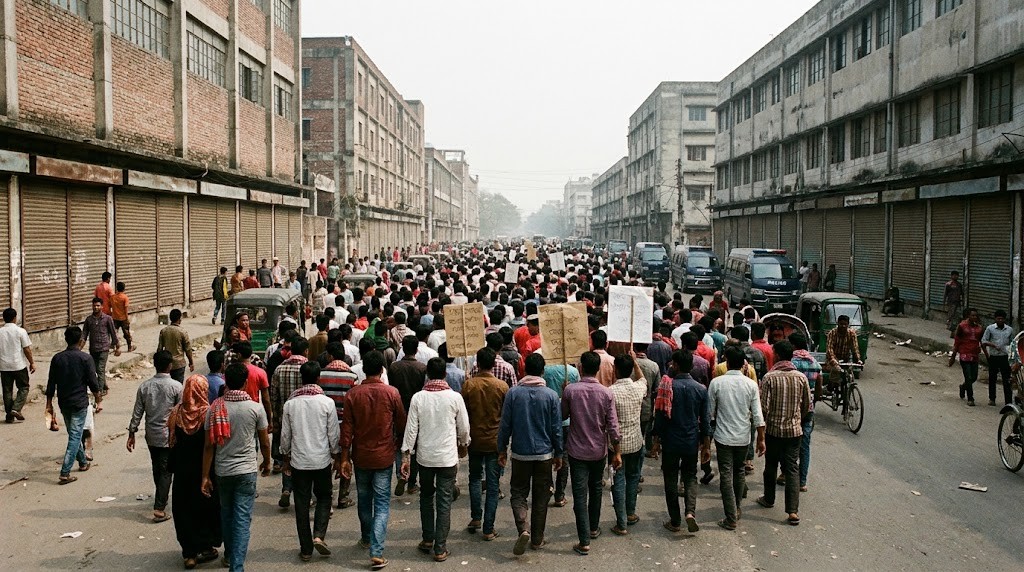
The government formed a new minimum wage board for garment workers on Sunday, 1 November, as it had promised. It did not stop the protests. Workers demanding a minimum monthly wage of Tk 30,000 blocked roads in Mirpur, Gazipur’s Kaliakair, Savar and Ashulia, and by the end of the day 529 factories had not run, according to an industrial-area summary reported by The Business Standard.
Labour and Employment Minister Ariful Haque Chowdhury announced the board at a press conference at the Secretariat in the morning. He said the government had already told the media, workers and owners that the board would be formed on Sunday, and asked protesting workers to go back to work, Prothom Alo reported. The minister later cancelled a planned trip to the United Arab Emirates because of the unrest.
What happened on the streets
- Gazipur: workers began protesting around 9am. The Dhaka-Tangail highway was blocked for about six hours and reopened at 3pm.
- Mirpur, Dhaka: workers and police clashed on and off between 11am and 1pm. Protesters set fire to a police vehicle under the Mirpur 11 metro station, and the Mirpur 10, Mirpur 11 and Pallabi stations were closed from noon to 2:30pm.
- Savar and Ashulia: protests, road blockades and vehicle fires were also reported.
How many factories and workers
The industrial-area summary for 1 November counted 987,190 workers who left their workplaces without working:
| Area | Factories affected | Workers who left |
|---|---|---|
| Gazipur and Mymensingh | 276 of 836 | 645,360 |
| Savar, Ashulia and Zirabo | 185 of 441 | 290,205 |
| Mirpur (DMP area) | 68 of 320 | 51,625 |
| Total | 529 | 987,190 |
Government, police and owners respond
Prime Minister Tarique Rahman met the home minister, the labour minister and other officials at the Secretariat on Sunday evening to discuss the situation, Prothom Alo reported.
Police said leaders and activists of the banned Awami League and its affiliated groups had joined the protests in Dhaka and Gazipur. Nine people were arrested in Kaliakair, and police detained 29 people in Mirpur over what they called a plan for sabotage. These are police claims and have not been independently verified.
Garment owners met at the BGMEA office in Uttara and decided to close factories temporarily under Section 13(1) of the Bangladesh Labour Act if workers do not return now that the board exists. BGMEA President Mahmud Hasan Khan Babu told The Business Standard he hoped normal production would resume on Monday.
Why it matters for the sector
Garments employ millions of workers, many of them women from rural districts, and wage decisions shape household spending on food, rent and school. Organisations working on labour rights, women’s economic empowerment, health and urban poverty will want to follow who sits on the board, when it first meets, and how long it takes to recommend a new wage. A closure under Section 13(1) allows owners to stop paying wages during an illegal strike, so a lockout would hit workers’ incomes quickly.
Read our earlier report: Garment workers clash with police as government moves to form wage board.
Sources
- Prothom Alo (in Bangla): Prime Minister meets officials on garment workers’ protests, 1 November 2026
- Prothom Alo (in Bangla): 29 detained in Mirpur over alleged sabotage plan, 1 November 2026
- The Business Standard: 529 garment factories closed amid workers unrest, 1 November 2026
- The Business Standard: RMG owners to close factories temporarily if workers don’t return to work, 1 November 2026
Image: AI-generated illustration, not a photograph of the events described.
Spotted an error? Tell us and we will correct it. Read our editorial standards.