The government will form a minimum wage board for Bangladesh’s readymade garment (RMG) sector, with a gazette notification due on 1 November, Labour and Employment Minister Ariful Haque Choudhury said on 31 October.
He announced the decision at a press conference at Srom Bhaban in Dhaka after meeting the Bangladesh Garment Manufacturers and Exporters Association (BGMEA) and the Bangladesh Knitwear Manufacturers and Exporters Association (BKMEA), The Business Standard reported. The government met labour leaders the day before.
What was agreed
- A new minimum wage board for garment workers, a key demand of workers’ groups.
- Factory owners accepted a three-year term for the board’s wage decision, instead of five years.
- Workers’ representatives and factory owners have both submitted nominees for the board.
- The government asked BGMEA and BKMEA to make sure unpaid wages and dues are cleared quickly at factories where workers have not been paid.
The minister urged workers to end the work stoppage now that the government had agreed to the board. “The decision has been taken to announce the wage board tomorrow,” he said, according to the newspaper. He also warned that some people might try to exploit the situation for reasons unrelated to workers’ welfare.
Update, 31 October evening: clashes in Gazipur
Protests continued after the announcement. At least 30 people were injured on 31 October when garment workers blocking the Dhaka-Tangail highway at Chandra in Kaliakair, Gazipur, clashed with law enforcement, Prothom Alo reported (in Bangla). At least 15 vehicles, including a police vehicle, were damaged, and 20 factories declared a holiday.
Workers are demanding a minimum monthly wage of Tk 30,000 (about US$245). They told the newspaper that rising prices and fewer overtime hours had made it hard to support their families. Protests over pay have continued in Konabari, Mouchak and other parts of Gazipur for two weeks, according to industrial police and workers quoted in the report.
Why it matters
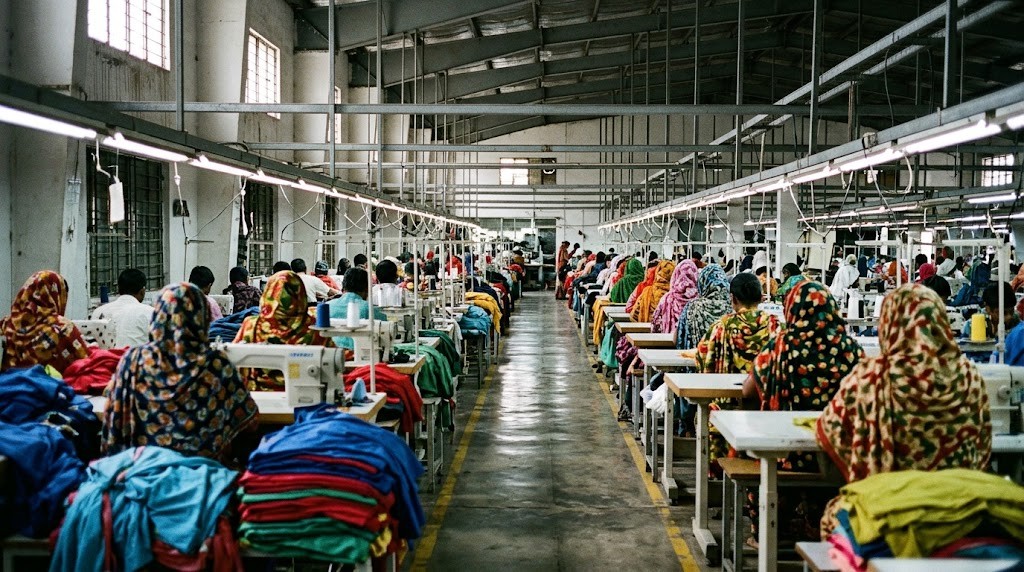
The garment industry is Bangladesh’s largest export earner and employs millions of workers, many of them women. A shorter wage cycle means pay could be reviewed more often as prices rise. NGOs working on labour rights, women’s economic empowerment and urban poverty will want to follow who sits on the board and how it consults workers. The timing also matters for exporters, who now have until 2029 to prepare for the loss of trade preferences after the UN extended Bangladesh’s LDC graduation.
What to watch
The gazette on 1 November and the board’s membership, whether workers return to the factories, how quickly unpaid wages are settled, and the timeline for the board’s wage recommendation.
This story is based on reporting by The Business Standard. It will be updated when the gazette is published. Image: an illustration generated with Google Gemini. It is not a photograph.
Sources
- Wage board announcement tomorrow, labour minister urges workers to return to work, The Business Standard, 31 October 2026
- গাজীপুরে শ্রমিক–পুলিশ দফায় দফায় সংঘর্ষ, আহত ৩০ (Workers and police clash repeatedly in Gazipur, 30 injured), Prothom Alo, 31 October 2026, in Bangla
Topics: livelihoods economic empowerment · national
Spotted an error? Tell us and we will correct it. Read our editorial standards.